Inside the demanding world of modern professional drifting, podium finishes is far more than purely a function of brute engine power or pilot courage. Rather, it has evolved into a intricate engineering challenge that demands a painstaking marriage of picking a time-tested car, outfitting it with the most precise competition hardware, and, most importantly, understanding its real-time performance on the course through cutting-edge drift telemetry software. This comprehensive handbook functions as your blueprint from the initial concept of a drift build through to the final telemetry-optimized adjustments that transform a powerful vehicle into a repeatable winner. We will delve deep into the methodical process of car suspension tuning, showing how a state-of-the-art drift tuning app like GripDial removes approximation and provides unmatched clarity into your car's true dynamics.
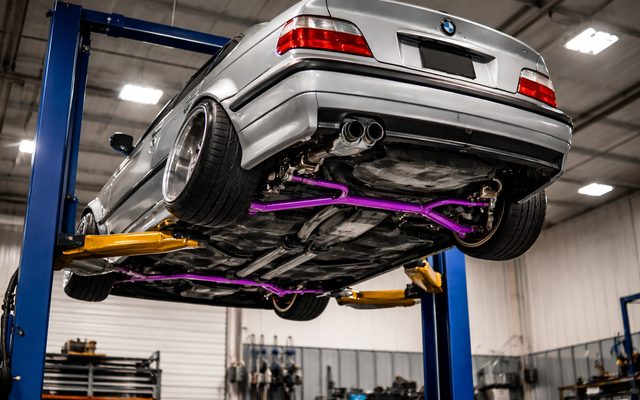
The cornerstone of any exceptional drift machine is, indisputably, the chassis itself. Certain platforms have earned renowned status within the worldwide oversteer community due to their built-in weight distribution, durable construction, and the enormous ecosystem of aftermarket components available. Selecting the correct car is the primary and most crucial choice a builder will make. For instance, the BMW E36 is widely regarded as one of the best balanced drift cars of the modern era. Its excellent 50/50 weight distribution, coupled with a RWD layout and extremely reliable straight-six powerplants, creates a platform that is both easy to handle for newcomers and incredibly capable in the hands of a pro driver. The next step of this philosophy, the E46 model BMW, improves on these qualities with a more sophisticated chassis, wider stance for improved stability, and even increased lock as standard from the manufacturer. A different powerful platform in the pro circuit is the Corvette C6.
This muscle-derived sports car brings a distinctive array of benefits to the drifting sport, including a low-mass aluminum frame, a rear-mounted drivetrain component that helps create an perfect front-to-rear mass ratio, and the colossal torque of a powerful LS V8 motor. This fusion renders it an utter weapon on track, able of entering and holding continuous angles with apparently minimal application of power. For those seeking outstanding performance per dollar, the 350Z model Nissan rises above as a top-tier choice. It comes from the factory with a rigid platform, a competent factory locking differential, and the smooth V6 engine that delivers ample horsepower and torque for learning and advancing in the activity. Its successor, the 370Z model, presents further refinements in structural rigidity, steering geometry, and outright motor power, cementing its place as a common selection among competitive drivers. Other legendary vehicles that merit mention include the agile Wankel-engined Mazda FC, the ubiquitous Nissan S13, the torque-rich Ford SN95, the modern BMW E90, and the tiny yet surprisingly engaging and forgiving Mazda Miata. Each of these cars provides a unique array of characteristics, challenges, and capabilities, but they all possess the core elements required to serve as a serious sliding vehicle.
However, selecting the optimal platform is merely the beginning. To access the complete capability of any of these vehicles, significant changes to the steering system and damping and springing systems are completely essential. This is where the world of specialist drift-spec hardware comes into critical view. The one most game-changing modification for a dedicated drift car is the fitting of a high-performance drift angle kit. These engineered systems, such as those manufactured by specialist companies like SLR Speed, are designed to significantly enhance the vehicle's possible turning lock. A OEM production vehicle is highly restricted in how far its front wheels can pivot, a engineering compromise for daily driving. In oversteer driving, but, extreme steering input is frequently necessary to catch and hold a slide. An modification kit substitutes the stock hubs, rod ends, and sometimes suspension arms with components that permit the wheels to reach steering lock in excess of 70 or even 80 °, compared to a average OEM limit of around 40 to 50 °.
This vastly expanded capability offers the pilot with significantly more authority during a drift, enabling it to be far simpler to initiate a slide, hold it through a extended turn, and switch smoothly from one side to the opposite. The difference in controllability is truly transformative. Combined with a appropriately chosen steering kit is the just as critical modification to the car's suspension. Store-bought or including high-end sport dampers are just not intended for the specific and brutal demands of drifting. A drift-spec set of coilovers is crucial. These engineered suspension components incorporate specific damping rates and spring stiffness that are tuned for the extreme mass transition that is inherent of sliding. When a driver initiates a drift, the chassis's weight is thrown forcefully to the front of the corner. Correct competition coilovers handle this movement in a predictable way, enabling the vehicle to stabilize quickly and offering the pilot clear response through the wheel and driver's seat. They additionally enable accurate tuning of stance, rebound and compression stiffness, and weight balance, which are all key elements of dialing in the chassis's handling to a given track or piloting style. In combination, a high-quality angle modification system and a properly selected pair of competition suspension units form the undeniable hardware cornerstone upon which all subsequent optimization is based.
Once the fundamental components is fitted, the next essential stage in the development is the meticulous adjustment of the chassis's suspension geometry. This is the realm of vehicle alignment optimization, a process that can seem intimidating to the newcomer but is, in practice, the key to converting a set of capable parts into a unified and consistent vehicle. The most critical aspect of alignment for sliding is definitely negative camber. Camber is the inclination of the rim compared to the vertical axis when viewed from the front of the vehicle. When the top of the wheel is tilted inward, this is called negative camber. For drifting, inward-leaning wheels on the steering tires is widely employed and is considered essential. The purpose is deeply related to tire contact.
When a chassis is going around a bend at limit sideways angles, the chassis leans toward the outside of the bend. This lean makes the outside front tire to lose its optimal grip area with the track surface. By adding negative camber, the wheel is pre-angled to counteract this roll. As the chassis rolls into the corner, the outside front tire flattens out with the track, maximizing its grip at the critical time when it is needed most for control. Commonly, front camber settings for a competition drift machine vary from approximately -3 degrees to as high as -5 degrees or even greater, contingent on the details of the vehicle configuration, compound selection, and operator style. The back wheels also employ negative camber, but the values are generally more conservative and subtler than the front axle. Excessive inward lean at the rear can cause the vehicle to extremely tail-happy and hard to control on acceleration application, as it diminishes the usable contact patch of the powered tires during straight-line power delivery. Hence, rear angles are frequently in the vicinity of -1 degree to -3 degrees, striking a careful compromise between giving enough cornering bite to aid in entering and holding the angle while simultaneously preserving effective traction for acceleration the turn. alignment is merely one element of the larger alignment equation, which additionally encompasses toe setting, self-centering steering, and bump steer correction.
Toe refers to the angle of the wheels as seen from the top. Inward toe means the front edges of the wheels are nearer together than the trailing edges, while outward toe means the converse. For drifting, a small amount of front axle toe-out is often employed to quicken the turn-in steering response, making the car feel more agile and eager to initiate a slide. Rear toe is typically set to zero or a incredibly minute amount of positive toe to foster stability under power. self-centering is the forward or aft tilt of the kingpin axis when looked at from the side-on of the car. Increased caster angle increases self-centering and stability stability, and it also increases negative camber effect during cornering, which is extremely advantageous. Adjusting these parameters is a complex dance where a modification to one value can and often will influence the other settings. The old-school method for dialing in a car's suspension geometry for competition has historically been a labor-intensive affair of guesswork and adjustment. A driver or engineering group would apply a change based on intuition, run the car on track, rely on the driver's subjective sensation and impressions, and then make another tweak. This drift angle kits loop would repeat again and again until the vehicle felt "acceptable" or the scheduled practice time ran out. This system is not only exceptionally slow in terms of hours and costs, but it is additionally fundamentally flawed.
Human feel is a notoriously subjective data source, affected by countless variables such as exhaustion, evolving track conditions, temperature, and simply the mindset of the pilot on that particular session. What feels "loose" on one run might feel "tight" on the next pass, leading to conflicting information and counterproductive adjustments. This age-old problem in chassis setup is precisely where modern engineering tools has intervened to completely change the methodology.
The rise and adoption of sophisticated suspension tuning applications has introduced a radically different paradigm for tuning and perfecting professional drift machines. This new generation of tools, represented by innovative products like GripDial, work by actively measuring the real-time dynamic movement of the car as it is being driven on the track. As opposed to depending on personal feel, these devices collect objective metrics on essential variables such as shock absorber movement, wheel speed, lateral and longitudinal g-forces, lock position, and driver input application. This acquired information flow is then processed by sophisticated algorithms that can visualize and interpret the metrics in a actionable way. For the first time, drivers and builders can observe exactly what the chassis is performing at every moment of a slide. This capability revolutionizes the entire chassis setup procedure. Imagine the particular goal of optimizing the front axle camber for a given chassis. Instead of applying a change from -3 degrees to -3.5 degrees and then testing multiple runs to try and "feel" a change, a suspension tuning tool can deliver immediate and clear information. The drift angle kits application can display in a chart how the tire's grip is acting during the critical phases of a slide: the initial flick, mid-corner, and transition. It can show if the present value is allowing the steering tire to keep ideal contact or if the compound is over-stressed on its outer edge.
The tool can then suggest fact-based advice for change. Perhaps the data indicates that the outside front tire is still stressing its sidewall at -3.5 degrees of camber, implying that an increase to angle, say -4 degrees, might be warranted. Alternatively, the data might show that the tire is not coming up to temperature or that the inner shoulder is wearing unevenly, which could point to that there is too much angle and a modest lessening back to -3.2 degrees would be more optimal. This level of precision and actionable analysis was literally impossible in the days of solely mechanical tuning.
The impact of utilizing a comprehensive suspension tuning tool goes well beyond merely optimizing camber. It functions as an essential suspension tuning guide that is customized to your specific vehicle. When setting the shock absorber settings on your suspension, rather than relying on imprecise tips or replicating another driver's numbers, you can utilize the software to observe how the vehicle is behaving in reaction to your adjustments. The application can display the wheel movement trace over a lap, revealing if the shocks are handling the body movement optimally or if they are causing the vehicle to oscillate uncontrollably after a direction change. It can aid in identifying challenges like hitting the bump stops or topping out, allowing you to introduce informed adjustments to preload settings, damping settings, or stance. This process translates similarly to the complex process of corner balancing. Beyond camber, the tool can offer insight into how adjustments to toe settings and caster angle are impacting the chassis's stability during various maneuvers of a drift. For example, it can allow you to find the best amount of front toe out for your particular steering rack geometry and piloting approach by showing the response time of turn-in reaction and the stability of the chassis at full steering angle. This turns the tool an extremely effective performance optimization handbook that is constantly calibrated by the live dynamics of your specific chassis on the tarmac. It elevates the complete project from a subjective skill into a scientific optimization process.
Moreover, the utility of a system like GripDial is in no way confined to experienced teams with extensive funding. For the amateur driver, it acts as an powerful educational tool. It practically provides the tuner with the analysis of a full-time race engineer without the typical expense. It accelerates the tuning process by giving clear directions to problems that would otherwise take seasons of experimentation to answer. A drift suspension tuning guide driver can understand how their specific vehicle responds to specific adjustments, building a deeper knowledge of vehicle dynamics in the journey. It additionally opens up advanced performance tuning principles, permitting every enthusiast with the ambition to optimize their machine to do so in a systematic and effective way. This is notably important in a discipline like drifting, where tuning expertise has historically been a tightly held advantage among top drivers. In the modern era, that knowledge can be in the garage of every dedicated enthusiast.
In summary, the process to constructing and tuning the ideal championship-contending sliding vehicle is a multi-faceted mission that perfectly integrates proven mechanical wisdom with 21st-century digital technology. It starts with the wise pick of a legendary chassis, then enhanced by the installation of essential drift-spec components like maximum-angle angle modification systems and expertly valved competition adjustable dampers. The build then advances into the detailed stage of chassis dynamics adjustment, where parameters like camber, toe, and caster angle are precisely configured to suit the car's modified geometry and the pilot's specific needs. The final step, and what really differentiates the contemporary approach from the past, is the integration of a powerful drift telemetry software. This tool eliminates the uncertainty and waste of purely seat-of-the-pants tuning by giving quantifiable, real-time telemetry on how the chassis is actually behaving. It acts as an unparalleled suspension tuning tool, a definitive drift suspension tuning guide, and a comprehensive vehicle dynamics tool. Together, this holistic approach guarantees that all aspect of the drift machine—from the choice of the car to the most minute adjustment on the coilover—is perfected for ultimate performance on the track. It represents the full evolution of the sport of drifting, connecting mechanical driving skill with precise chassis dynamics to build the ultimate effective vehicles imaginable.